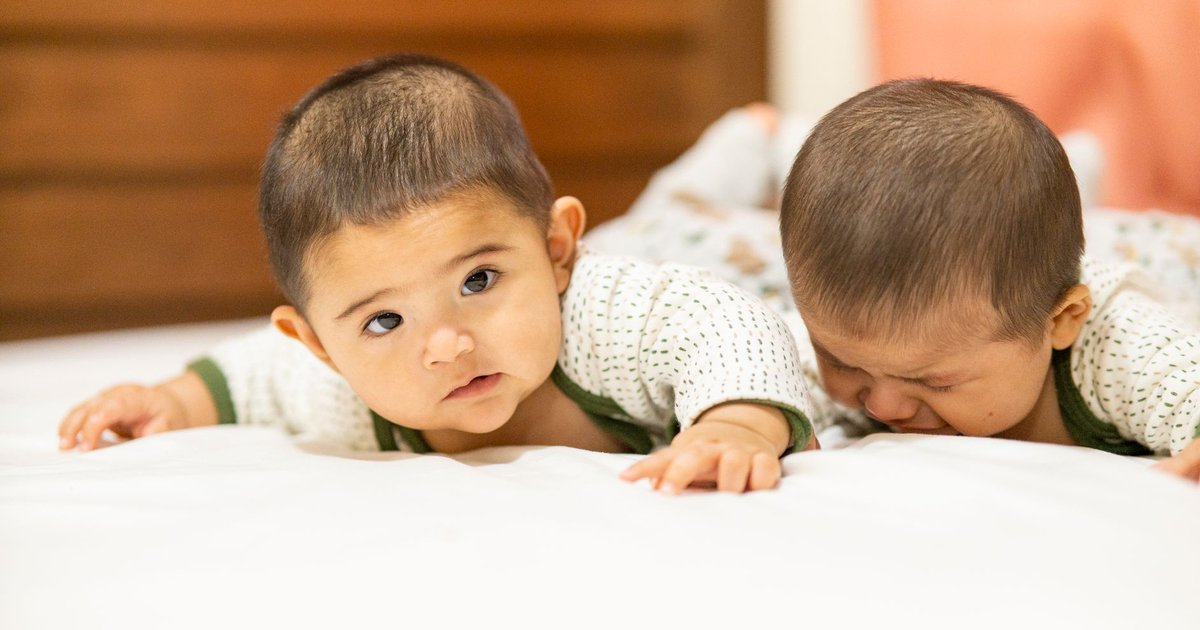
Twin naming is one of the most interesting challenges in baby naming: you need two names that work together and work independently, that are distinct enough to give each child their own identity, and that make sense as a set without being too matchy or too clever.
Here's a data-driven guide using the 2024 SSA rankings.
The rules (such as they are)
Before the pairs: a few principles that show up in the data and in naming research.
Matching first letters is the most popular strategy. Emma and Ethan (#2 and #28) are currently the most common twin pair across the US. Parents like the visual symmetry of the same initial without rhyming.
Avoid rhyming. Jayden and Hayden was a 2000s trend. Matching rhyme tends to make individual identity harder and sounds coordinated in a way that can feel childish as they grow up.
Different rhythm works better than same rhythm. Oliver and Olivia (same root, different ending) can feel too clever. Oliver (#3) and Isla (#35) are different lengths and sounds but share a quality.
Consider how they sound called out together. "Elliot and Eleanor!" vs "Aiden and Jayden!" — the first pair has names of different rhythm; the second feels like one repeated word.
Boy-girl pairs
Classic and balanced
Oliver & Eleanor — #3 and #14. Both are English-heritage, historically rich, good nickname options (Ollie/Ollie or Nell), and clearly distinct. Different lengths (3 syllables vs 4) helps them sound like individuals.
Theodore & Charlotte — #4 and #4. A historically matched pair: both peaked in the 1890s and are reviving together. Theo and Charlie as nicknames. Presidential (Roosevelt) and royal (Princess Charlotte) weight. This may already be the most fashionable twin pair of the decade.
Henry & Eleanor — #6 and #14. The royal historical pair — Henry and Eleanor were actual royals in medieval England (Henry II and Eleanor of Aquitaine). Now among the most popular names in the US simultaneously.
Sebastian & Sophia — #7 and #6. S-pair without matching too closely. Both are historically Romance-language names now fully assimilated into English naming.
Elijah & Eliana — #8 and #18. Both Hebrew/biblical, both four syllables, both start with El-. The risk here is too-matchy; the advantage is thematic coherence. Eli and Ellie as nicknames.
Noah & Nora — #2 and #22. N-pair, both short, both Old Testament (Noah) and Irish (Nora), but different enough in feel and length. These are currently near-guaranteed sibling names by accident — many families with a Noah have a Nora or vice versa.
James & Juliet — #11 and #183. Classic English names, alliterative J, very different lengths (1 syllable vs 3). James is timeless; Juliet is literary and romantic.
Lucas & Luna — #37 and #13. Both L names with Latin roots (lux/luna), clean and modern-feeling.
Celestial pairs
Luna & Orion — #13 girls / #325 boys. The moon and the hunter constellation. Both are mythological/astronomical, both are climbing, and they're clearly distinct.
Aurora & Atlas — #16 girls / #101 boys. Roman dawn goddess and Greek titan holding up the world. Different mythological traditions (Roman vs Greek), different sounds, both striking.
Nova & Aries (or Ares) — #39 girls / #295 boys. Both are sky/astronomy names; Nova is the stellar explosion, Aries is the ram constellation. Ares has the advantage of a defined mythology.
Stella & Leo — #48 and #24. Latin for star and lion. Brief, strong names with astronomical associations. Also a reference to the famous A Streetcar Named Desire scene ("Stella!") which may or may not matter to parents.
Mythological pairs
Athena & Apollo — #90 girls / #414 boys. Greek goddess of wisdom and god of the sun. Majestic and clearly matched thematically without rhyming.
Iris & Orion — #71 girls / #325 boys. Both Greek mythological figures (goddess of the rainbow; the hunter). Different genders, different etymology, shared cultural family.
Penelope & Perseus — #28 girls / rare for boys. Penelope is top 30; Perseus is still very rare. High-literary, both Odyssey-adjacent. If the parents want something distinctive, this works.
Vintage revival pairs
Theodore & Josephine — #4 and #291. Both early-20th-century names currently reviving (Teddy and Josie). The vintage revival wave is producing natural twin pairs.
Arthur & Clara — #105 and #212. Both peaked in the early 1900s and are reviving. Old-world gravitas, great nicknames (Art/Artie and Clara doesn't really need one).
Emmett & Violet — #119 and #15. Emmett is solidly vintage-revival; Violet is at #15 after decades of obscurity. Both feel like 1920s names waking up.
Jasper & Hazel — #133 and #19. The definitive vintage-revival pair. Jasper and Hazel are both early-20th-century names; both evoke a specific kind of natural, antique-feeling aesthetic. These names appear together in parents' lists more often than any other vintage pair.
Arlo & Wren — #146 and #213. Both short, both nature-adjacent, both resolutely uncommon but climbing. Arlo has the folk-music history; Wren is the small but fierce bird.
Boy-boy pairs
Theodore & Oliver — #4 and #3. The two biggest vintage-revival boy names simultaneously. Both are English-heritage with warm nicknames (Theo/Ollie).
Liam & Lucas — #1 and #37. L-pair. Liam is the #1 name; Lucas is established and familiar. Different enough in length (2 vs 3 syllables).
Ezra & Elijah — #13 and #8. Biblical E-pair. Both Old Testament, both currently top 15. Eli works as a short form for both, which could be confusing — better as full names.
Henry & James — #6 and #11. Two of the most classic, historically deep English boys' names. No nickname confusion, completely distinct sounds, both associated with kings and explorers.
Noah & Leo — #2 and #24. Both short (2 syllables and 2 syllables), both simple, different origins (Hebrew and Latin).
Sebastian & Atticus — #7 and #277. Sebastian is well-established; Atticus is the literary dark horse. S and A, different lengths.
Jasper & Silas — #133 and #81. Vintage pair; both have the New Testament/early American settler feel. Both are climbing.
Arlo & Milo — #146 and #157. Both short, -o ending pairs. Arlo is folk/rustic; Milo is classic. The rhyme risk here (both -lo) is mild since they don't rhyme exactly.
Girl-girl pairs
Olivia & Emma — #1 and #2. The statistical most-common twin pair in the current data. Both are at the absolute top, both are English-heritage, both have elegant simplicity. The risk: they're so popular that many non-twins have these names, which may matter to parents who want their twins to feel special.
Charlotte & Eleanor — #4 and #14. Both long English names, both historically rich, both currently climbing. Charlie and Nell as nicknames. This pair has a Downton Abbey quality.
Aurora & Violet — #16 and #15. Color-adjacent pair (dawn/violet). Both are nature/nature-culture names at virtually the same rank. Rory and Vi as informal shorts.
Luna & Stella — #13 and #48. Star/sky Latin pair (moon and star). Both short, both luminous. Luna and Stella have been used as a matched set by parents who know enough Latin to see the theme.
Hazel & Iris — #19 and #71. Botanical pair. Hazel is the tree; Iris is the flower. Both are vintage-revival names that fit the same aesthetic exactly. Different lengths (2 vs 2 syllables) and sounds.
Rosie & Daisy — #311 and rare. Floral pair, both informal and warm. Rosie is still climbing; Daisy is outside the mainstream. The informal quality helps them work as a set.
Wren & Fern — #213 for Wren / very rare for Fern. One-syllable nature pair. Short and clear. Wren is climbing fast; Fern is nearly unused. This would make genuinely distinctive twins.
Eloise & Adelaide — #168 and rare. French vintage revival pair. Long, elegant, different rhythms. Both are Edwardian in feel.
What the data says about twin naming
Twin births are currently about 32 per 1,000 births in the US — roughly 3.2% of all births. There are approximately 120,000 pairs of twins born annually.
The most popular strategies in the current data:
- Matching first letter without rhyming (Emma/Ethan, Noah/Nora)
- Thematic pairing (celestial, vintage, biblical, nature)
- Complementary lengths (one short, one longer)
- Independent viability — both names should work on their own, not only as a set
The strategies parents tend to regret:
- Rhyming names (Jayden/Hayden, Aiden/Jaiden)
- Names that only work as a pair (calling them "Jack and Jill" type pairs — cute at 5, awkward at 35)
- Both names being at #1/#2 (they'll constantly meet other people with their name)
Explore names: Oliver · Eleanor · Theodore · Charlotte · Luna · Jasper · Hazel
Data: SSA 2024 US release. All ranks are within-sex.